
There’s no question about it: recent investments of millions of dollars by Sydor Optics, John and Barbara Bruning, and SPIE—along with academic, state, and federal government funding—speaks volumes about their commitments to the industry and will make the new Monroe Community College (MCC) Sydor Optics Advanced Technology Center (ATC) in Rochester, NY, a reality in the fall of 2026.
The MCC Optical Systems Technology program—the nation’s first, established in the 1960s, and still one of only a few associate-degree programs—struggled to stay afloat for many years. Since 2015, however, thanks to industry and government support and the leadership of Alexis Vogt, PhD, Endowed Chair and Professor of Optics at MCC, the program has seen a 2,960 percent increase in student enrollment. While optics technician training programs were practically non-existent until the last few years, the need for technicians has increased tenfold. Long-time technicians in the field are nearing retirement age, and the next-generation workforce is in high demand.
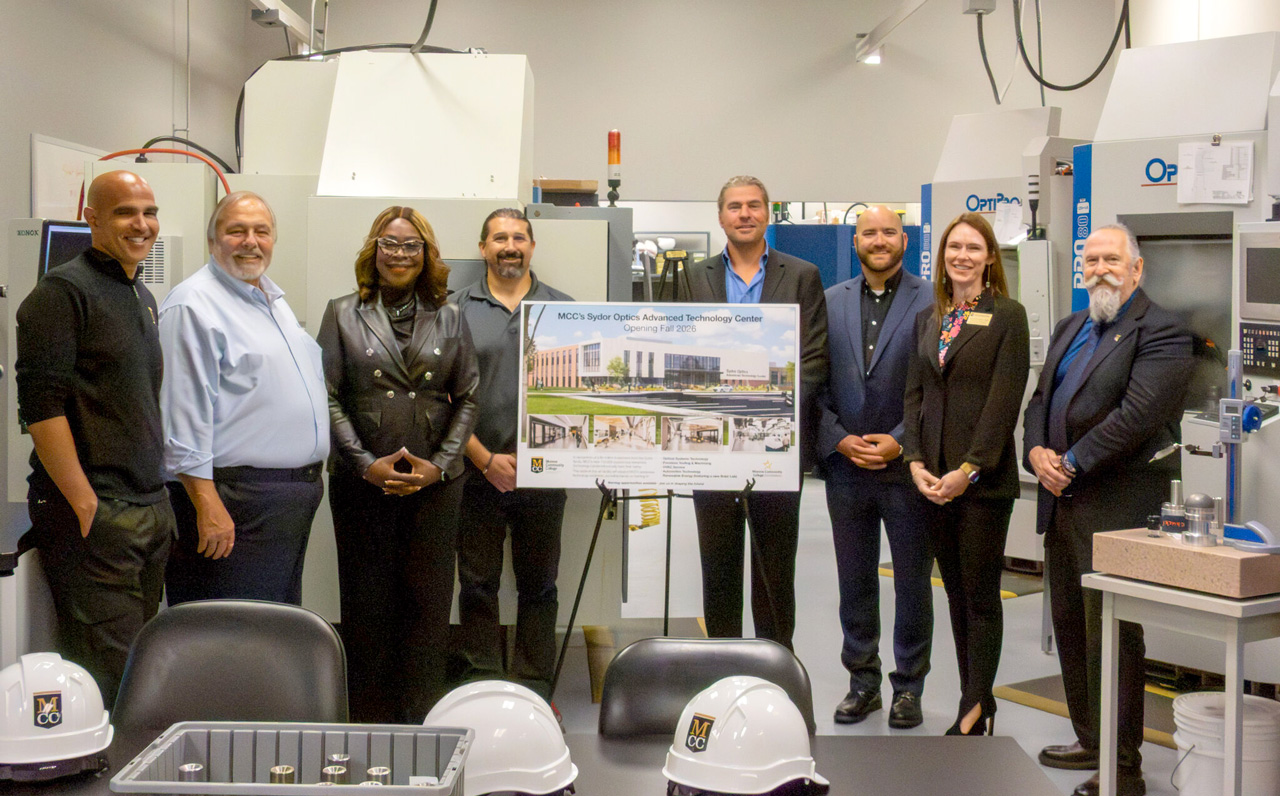
Left to right: Jason Brightful, Jim Sydor, Dr. DeAnna R. Burt-Nann, Mike Pomerantz, Matthew Sydor, Jonathan Sydor, Dr. Alexis Vogt, and Dr. Dean Laury pose with a rendering of the Sydor Optics Advanced Technology Center, made possible with a $3 million gift from Sydor Optics. (Photo provided by MCC)
There’s no question about it: recent investments of millions of dollars by Sydor Optics, John and Barbara Bruning, and SPIE—along with academic, state, and federal government funding—speaks volumes about their commitments to the industry and will make the new Monroe Community College (MCC) Sydor Optics Advanced Technology Center (ATC) in Rochester, NY, a reality in the fall of 2026.
The MCC Optical Systems Technology program—the nation’s first, established in the 1960s, and still one of only a few associate-degree programs—struggled to stay afloat for many years. Since 2015, however, thanks to industry and government support and the leadership of Alexis Vogt, PhD, Endowed Chair and Professor of Optics at MCC, the program has seen a 2,960 percent increase in student enrollment. While optics technician training programs were practically non-existent until the last few years, the need for technicians has increased tenfold. Long-time technicians in the field are nearing retirement age, and the next-generation workforce is in high demand.
Left to right: Jason Brightful, Jim Sydor, Dr. DeAnna R. Burt-Nann, Mike Pomerantz, Matthew Sydor, Jonathan Sydor, Dr. Alexis Vogt, and Dr. Dean Laury pose with a rendering of the Sydor Optics Advanced Technology Center, made possible with a $3 million gift from Sydor Optics. (Photo provided by MCC)
To grow the training programs that will supply new technicians, industry and government support is critical. Using MCC’s Optical Systems Technology program as a model, the American Center for Optics Manufacturing (AmeriCOM)—funded and selected by the Department of Defense (DoD) to build and sustain the nation’s precision optics industrial base—has facilitated the growth of training programs across the country. These include Front Range Community College’s (FRCC) Optics and Laser Technology program; Sussex County Community College’s (SCCC) and Valencia College’s Optics Technology programs; and Keene State College’s (KSC) Precision Optics Certificate Program. Additional programs are currently being established. Sustaining and expanding these efforts depends not only on government support, but also on continued industry involvement to keep programs viable and thriving.
So what can small, mid-sized, and large optics, photonics, or laser optics companies do to help these programs grow and continue graduating the next generation of optics technicians?
- Establish or join a regional optics industry cluster to represent the strength and collective voice of the industry
- Serve on the regional advisory board of an academic institution
- Assist with setting up labs and developing curriculum at colleges or training centers to ensure graduates are work-ready and meet the needs of regional employers
- Provide a pipeline of instructors to colleges (read more here)
- Serve as ambassadors and promote the industry through marketing efforts such as social media
- Provide financial support or donate equipment and supplies to college labs for hands-on training
- Most importantly, include apprenticeships and micro-credential (upskilling) programs in long-term human resources strategies
“The future of the optics and photonics industry depends on the strength of our workforce pipeline. When companies invest in education—through advisory boards, apprenticeships, equipment donations, and mentorship—they are not simply supporting a college program. They are investing in the technicians and innovators who will power the next generation of breakthroughs in defense, health care, manufacturing, and space. The collaboration we are building at Monroe Community College demonstrates how industry, education, and philanthropy can work together to secure the future of American optics.”
Professor Alexis Vogt, Monroe Community College, and AmeriCOM, Workforce and Higher Education Executive Director.
In addition to college-based training programs, AmeriCOM is partnering with academic and industry organizations to provide online optics curriculum and currently offers in-house training to upskill established technicians at its COM-Lab facility in Fairport, NY.
This type of involvement not only strengthens the industry as a whole but also delivers measurable benefits to the bottom line for every company that makes the commitment.
To learn more about offering program support, contact Magda Hernandez Otero, AmeriCOM Program Manager, Workforce Development at motero@americom.org.